
Processing guidelines and expert knowledge for optimal CSW Fiber integration
加工工艺指南与常见问题解答
The complete HM003 / HM003S reference in one bilingual document — specifications, grade selection, application fields, processing guidance, FAQ and packaging details.
HM003 / HM003S 完整资料汇编于同一份中英双语文档 —— 产品技术参数、选型指南、应用领域、加工工艺建议、常见问题与包装物流信息。
Opens directly in your browser — no download required. 18 pages in A4 layout; please use a desktop or tablet screen for the full page width.
在浏览器中直接打开,无需下载。共 18 页 A4 版式,请在桌面端或平板端查看以获得完整页面宽度。
Best practices for integrating CSW into your compound
硫酸钙晶须混配加工最佳实践
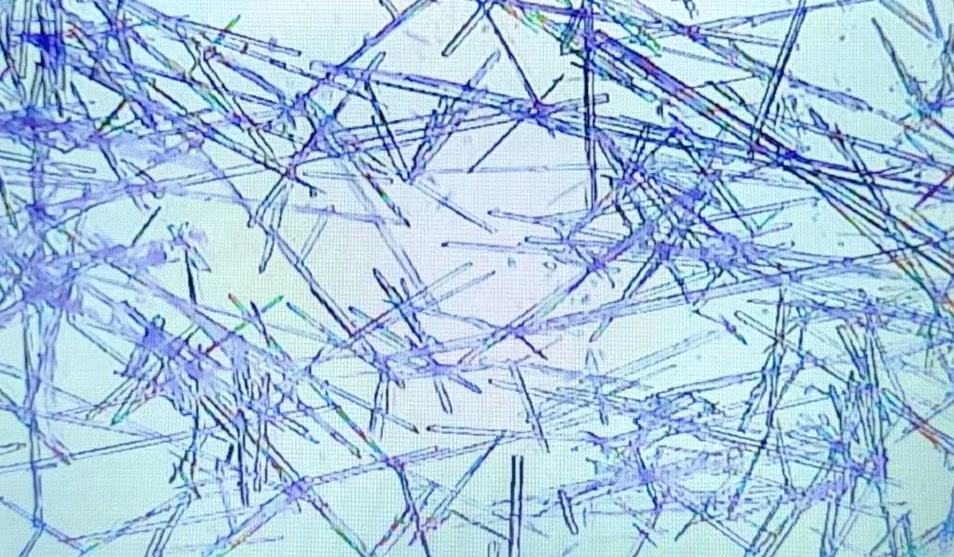
Real CSW Whisker Microstructure (Optical Microscopy)
真实CSW晶须微观结构(光学显微镜)
Although CSW Fibers have low moisture absorption, pre-drying is recommended for high-performance applications. Dry at 105-120°C for 2 hours to achieve moisture content below 0.1%. For the surface-treated grade HM003S, keep the drying temperature at the low end of this range; the thermal stability of its treatment layer has not been published, so confirm the limit from the lot QC data supplied with the material.
虽然CSW晶须吸湿性低,但高性能应用建议预干燥。105-120°C干燥2小时,使含水率降至0.1%以下。表面处理型HM003S建议取该区间的下限;其处理层的热稳定性数据尚未发布,请以随货QC数据确认上限。
Common starting point: Side-feeding via loss-in-weight feeder at the mid-section of a twin-screw extruder. This limits shear exposure and helps retain whisker length and aspect ratio; compare routes on your own line. For single-screw systems, pre-blend CSW with resin pellets using a high-speed mixer (500-800 rpm, 3-5 minutes) before main feed.
常用起始方案:通过失重式喂料器在双螺杆挤出机中段侧喂料,可减少剪切暴露、有利于保留晶须长度与长径比;具体路线请在贵方产线上对比验证。单螺杆系统需先用高速混合机(500-800 rpm,3-5分钟)将CSW与树脂预混后主喂料。
Twin-screw (co-rotating): L/D ≥ 40, screw speed 200-400 rpm
Temperature profile (PA6 example): 220-240-250-255-250-245°C (feed to die)
Temperature profile (PP example): 180-190-200-205-200-195°C
Temperature profile (PLA for 3D printing): 170-180-185-185-180-175°C
Keep shear moderate to preserve whisker integrity. Use gentle conveying elements in the screw configuration near the side feeder.
双螺杆(同向旋转):L/D ≥ 40,螺杆转速200-400 rpm
保持适度剪切以保护晶须完整性。侧喂料口附近螺杆构型使用温和输送元件。
Use strand pelletizing or underwater pelletizing. For strand cutting, maintain blade sharpness and set cutting speed to match extrusion rate. Target pellet length: 2.5-3.5mm. Underwater pelletizing is preferred for higher CSW loadings (>25%) to ensure uniform pellet quality.
使用拉条切粒或水下切粒。拉条切粒需保持刀片锋利,切粒速度与挤出速率匹配。目标粒料长度2.5-3.5mm。高填充量(>25%)推荐水下切粒。
Melt temperature: Follow resin manufacturer guidelines + 5-10°C compensation for filler
Mold temperature: 60-80°C for semi-crystalline, 30-50°C for amorphous resins
Injection speed: Medium-high (avoid excessive shear that breaks whiskers)
Holding pressure: 60-80% of injection pressure
Back pressure: 5-15 bar (low to moderate to preserve fiber length)
注塑温度遵循树脂厂商建议并补偿5-10°C。中高速注射,背压5-15 bar(低到中等以保护晶须长度)。
General starting windows for designing your own trial — not Hancore-qualified settings, and no property outcome is implied
用于设计贵方试验的一般性起始区间——不是Hancore认证参数,也不隐含任何性能结果
| Application应用领域 | Resin Matrix树脂基体 | Trial Window试制区间 | Grade to Start With起始型号 | Evaluation Directions评估方向 |
|---|---|---|---|---|
| Engineering Plastics工程塑料 | PA6, PA66, PBT | 15-30 wt% (window only)(仅区间) | HM003 | Stiffness vs. notched impact, HDT, warpage, dispersion刚性与缺口冲击、热变形温度、翘曲、分散性 |
| PP / PE CompoundingPP、PE共混改性 | PP, PE | 10-25 wt% (window only)(仅区间) | HM003 | Stiffness, shrinkage anisotropy, surface finish, cost-in-use刚性、各向异性收缩、表面光洁度、使用成本 |
| 3D Printing3D打印 | PLA, ABS, PETG | To be established by trial需试制确定 | To be determined待评估确定 | Filament processability, extrusion consistency, interlayer bonding, dimensional stability线材可加工性、挤出一致性、层间结合、尺寸稳定性 |
| Automotive汽车 | PP copolymerPP共聚物 | 15-25 wt% (window only)(仅区间) | HM003 | Part-level dimensional stability, surface replication, heat ageing零件级尺寸稳定性、表面复刻性、热老化 |
| Friction Materials摩擦材料 | NAO / Semi-metallicNAO/半金属型 | Formulation-specific, set by the pad developer按配方确定,由刹车片配方开发方设定 | HM003 | Friction stability across the duty cycle, fade/recovery, NVH, counter-face wear工况全程摩擦稳定性、热衰退与恢复、NVH、对偶件磨损 |
HM003S is not listed as a starting grade above because its parameters are still pending confirmation. Where a surface-treated grade is worth evaluating, run it in parallel with HM003 on the same resin and line.
上表未将HM003S列为起始型号,因其参数仍有待确认。若需要评估表面处理型,建议在同一树脂与产线上与HM003平行试制。
Expert answers to common questions about CSW Fibers
关于硫酸钙晶须的常见技术问题解答
CSW Fibers and glass fiber serve different reinforcement roles. Glass fiber provides high absolute strength but can produce fiber blush on surfaces and is more abrasive to processing equipment. The whisker morphology supports a better surface finish with less fiber read-through, and its mineral hardness is lower than that of glass, which reduces equipment wear. Density is 2.69 g/cm³ for CSW against roughly 2.54 g/cm³ for E-glass, so CSW is not a density advantage over glass fiber — any part-weight effect has to be calculated on the specific formulation. Comparative material cost depends on your current filler system and order volume, so we work it out with you on your own figures. For maximum structural strength, a hybrid approach using both CSW and short glass fiber is one option worth trialling.
CSW晶须与玻璃纤维承担不同的增强角色。玻璃纤维绝对强度高,但易产生纤维外露,对加工设备磨损更大。晶须形态有助于改善表面质量、减少纤维透印,矿物硬度低于玻璃,设备磨损较小。CSW密度为2.69 g/cm³,E玻璃约2.54 g/cm³,因此相对玻璃纤维并不构成密度优势——制件减重效果需按具体配方核算。材料成本对比取决于您现用填料体系与订购量,需按贵方数据共同测算。若以结构强度为首要目标,CSW与短切玻纤复合使用是值得试制的方案之一。
Melt viscosity is a processing property we characterise on your formulation, so we do not publish comparative percentage figures. What the morphology supports as an evaluation direction: needle-like whiskers interact with the melt differently from plate-like fillers such as talc or mica, so the viscosity/price and viscosity/fill-level trade-off is worth measuring side by side against your current filler system. For HM003S, the effect of the surface treatment on melt rheology has not been measured by us and is not published — treat it as one of the comparison items when you trial HM003S against HM003. Recommended characterization at each loading level: melt flow rate at the resin's standard temperature and load, capillary or parallel-plate rheology if available, plus torque curve and motor load on your own line.
熔体粘度属于需在贵方配方上表征的加工性能,我们不发布对比性百分比数据。可作为评估方向的是:针状晶须与熔体的相互作用方式与滑石粉、云母等片状填料不同,因此"粘度—成本"与"粘度—填充量"的权衡值得与现用填料体系平行实测。HM003S表面处理对熔体流变的影响尚未经我方实测,不予发布,请在HM003S与HM003的平行试制中作为一项对比内容。建议在各添加量下表征:树脂标准温度与负荷下的熔体流动速率,有条件的可做毛细管或平行板流变,并在产线上记录扭矩曲线与电机负载。
Calcium sulfate whisker is compatible with both virgin and recycled polymer matrices, and regrading recycled resin with mineral filler is an established practice in the industry. What CSW does for a given recycled stream — which property recovers, and by how much — depends on the feedstock source, the degradation level of the incoming resin and your re-compounding conditions, so we do not publish performance-recovery figures. A workable evaluation is: establish the unfilled recycled resin as a baseline, then build a loading series and measure tensile strength, modulus and impact against that baseline and against virgin resin. We can supply HM003 samples for that trial; HM003S can be included as a comparison arm once its treatment specification is confirmed.
硫酸钙晶须与原生及回收聚合物基体均可相容,以矿物填料对回收料进行性能重整在行业内是成熟做法。CSW在某一具体回收料体系中能带来什么——哪项性能恢复、恢复多少——取决于回收料来源、入料树脂降解程度与再共混工艺,因此我们不发布性能恢复数据。可行的评估方式:以未填充回收料为基准,设置添加量梯度,测量拉伸强度、模量与冲击,并分别与"未填充回收料"和"原生树脂"两条基线对比。我方可提供HM003样品用于该试制;HM003S可在其表面处理剂规格确认后作为对比项加入。
Calcium sulfate (CaSO₄) is inherently non-toxic and is listed as GRAS (Generally Recognized As Safe) by the FDA for certain applications. Our CSW Fibers meet heavy metal limits per RoHS and REACH regulations. For specific food-contact or medical device applications, we can provide FDA-compliant grades with full migration testing documentation. Please contact our technical team to discuss your regulatory requirements.
硫酸钙本身无毒,在某些应用中被FDA列为GRAS(一般认为安全)。我们的CSW晶须符合RoHS和REACH重金属限量要求。对于食品接触或医疗器械应用,我们可提供FDA合规级别产品。
The figure we publish — heat resistance ≥1000 °C — refers to the inorganic whisker material itself. It is not the service temperature of the final polymer composite, and it is not a compounding temperature limit. In practice the ceiling is set by your resin, not by the whisker: most thermoplastics are processed below 300 °C, while high-performance resins such as PPS, PEEK and PEI are processed above that. The thing that deserves more attention at processing temperature is the crystallization water in the calcium sulfate lattice, which is why the pre-drying guidance above (105–120 °C, roughly 2 h) matters more in day-to-day compounding than the whisker's own heat resistance. Ask us for lot QC data so you can check suitability against your own barrel profile. For HM003S, the thermal stability limit of the surface treatment has not been measured by us and is not published — treat that as an open item to settle with lot data plus a trial at your processing temperature.
我方发布的"耐热≥1000 °C"指无机晶须材料本体的特性,不是最终聚合物复合材料的使用温度,也不是共混加工温度上限。实际上限由您的树脂决定,而非晶须:多数热塑性塑料在300 °C以下加工,PPS、PEEK、PEI等高性能树脂则高于此值。在加工温度下更值得关注的是硫酸钙晶格中的结晶水,因此上文预干燥建议(105–120 °C、约2 h)在日常共混中比晶须本体耐热更具实际意义。请向我方索取批次质检数据,与贵方螺杆温度曲线核对适用性。HM003S表面处理层的热稳定性上限尚未经我方实测,不予发布,应作为待解决项,以批次数据加上贵方加工温度下的试制来确认。
CSW Fibers have a shelf life of 24 months when stored in original sealed packaging in a cool, dry environment (below 30°C, relative humidity below 70%). Once opened, reseal bags immediately and use within 6 months for optimal performance. Avoid direct sunlight and contact with water. If material has absorbed moisture, re-dry at 105°C for 2 hours before use.
原装密封包装存放于阴凉干燥环境(30°C以下,相对湿度70%以下),保质期24个月。开封后立即重新密封,6个月内使用。如已吸潮,使用前105°C干燥2小时。
For standard grades (HM003, HM003S), the minimum order quantity is 12.5 kg (one bag). Sample quantities of 1-4kg are available for evaluation purposes at a nominal charge, which is credited against your first production order. For custom grades, the minimum order is 500kg. Contact us for pricing and availability.
标准型最低起订量12.5 kg(一袋)。可提供1-4kg样品用于评估,首次量产订单可抵扣样品费用。定制型最低起订量500kg。
Our application engineers provide free formulation guidance and processing optimization.
我们的应用工程师免费提供配方指导和加工优化服务。
Contact Technical Team → 联系技术团队 →